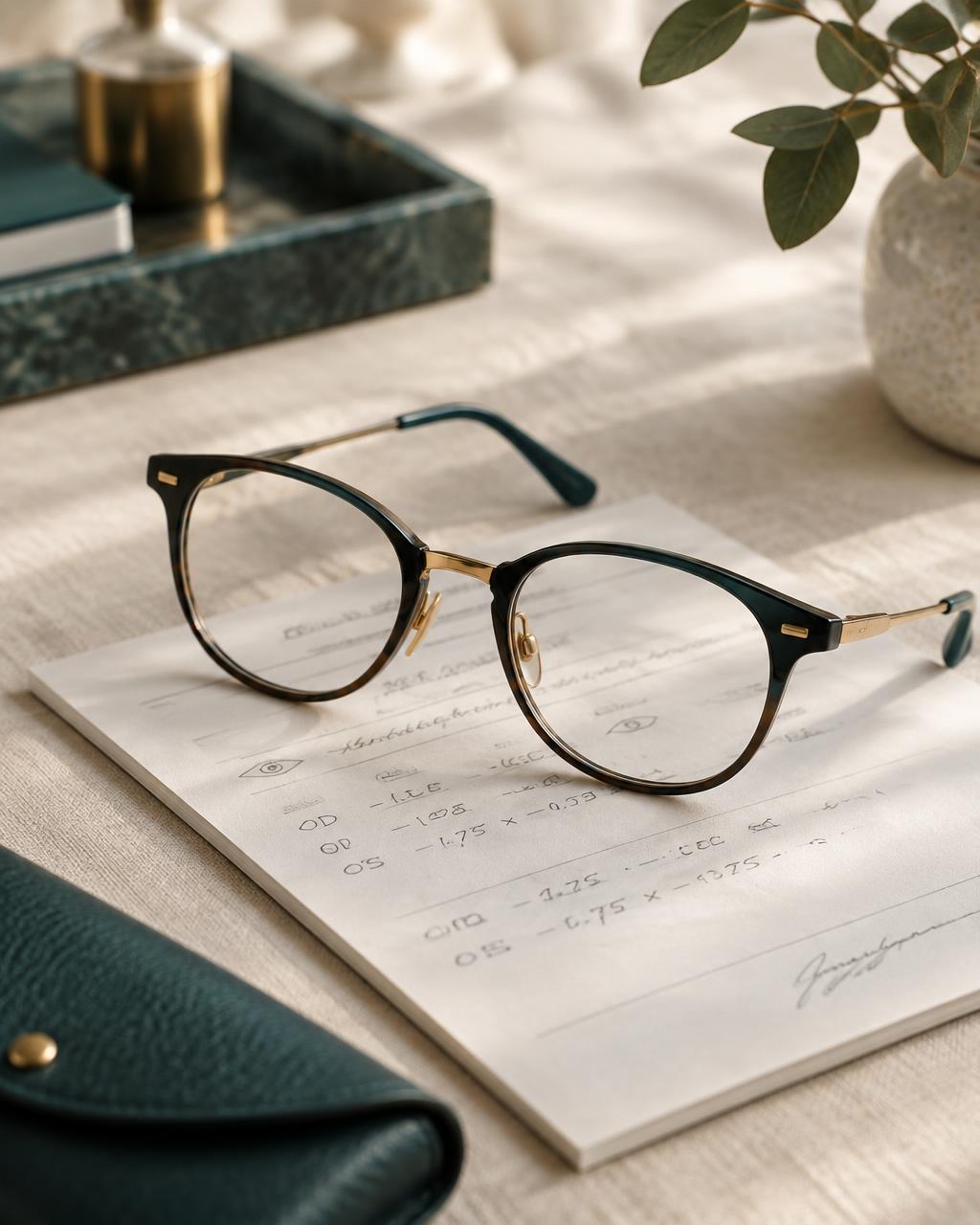
What a prescription tells us
Most people need their eyesight corrected at some point in their lives. The usual reason is a refractive error, where the eye does not bend (refract) light as it should, causing blurred vision. Your prescription records the lens power needed to focus light correctly again. A refractive error does not necessarily mean your eyes are unhealthy, and it can usually be corrected with glasses or contact lenses.
Short-sightedness (myopia)
Myopia happens when light is focused in front of the retina rather than on it. Distant objects look blurry while close objects stay clearer. It can develop at any age and has been linked to both genetic and environmental factors, including prolonged close work. Glasses or contact lenses refocus the light onto the retina. On your prescription, myopia is shown with a minus sign in the SPH column.
Long-sightedness (hypermetropia)
Hypermetropia, sometimes called hyperopia, happens when light would come to a focus behind the retina. Close objects look blurry while distance vision may be clearer. If it is significant and left uncorrected, it can lead to poor near vision, headaches and eye strain, particularly in adults. It often becomes more noticeable with age. On your prescription, long-sightedness is shown with a plus sign in the SPH column.
Astigmatism
Astigmatism happens when light is not brought to a single focus on the retina, often because the front of the eye is shaped more like a rugby ball than a football. It blurs both near and distance vision and, if uncorrected, can cause headaches and eye strain. Most people who are short- or long-sighted have some degree of astigmatism. It is corrected by the CYL and axis values on your prescription.
Presbyopia — changing near vision
The lens inside your eye is flexible and adjusts its focus as you look between distances. From your early forties onwards it gradually becomes stiffer, making it harder to focus on close objects such as small print, especially in poor light. Presbyopia is a normal age-related change, not a disease. It can be corrected with reading glasses, or with bifocal or varifocal lenses that cover distance and near in one pair. The reading addition appears in the Add column of your prescription.
SPH — sphere
SPH stands for sphere and shows the strength of lens you need, measured in dioptres. A minus sign means you are short-sighted; a plus sign means you are long-sighted. The number may be small, like 0.25, or larger, like 6.00 — the higher the number, the stronger the correction. You may see PL or plano, which means no spherical correction is needed in that eye. It is common for the two eyes to have different values.
CYL and axis
CYL stands for cylinder and shows the amount of lens power needed to correct astigmatism. The axis is the angle, between 1 and 180 degrees, at which that cylindrical power must be positioned in the lens. A higher axis number does not mean a stronger prescription — it simply describes the orientation. If you have no astigmatism, the box may be empty or marked DS (dioptre sphere).
Prism and base
Prism is prescribed when the eyes have some difficulty working together as a pair, helping to prevent double vision or the headaches that can come from it. The number shows the strength of the prismatic correction, and the base shows the direction in which the prism acts. Most prescriptions have no prism at all.
Add — the reading addition
The add is the extra power needed for close work, and it becomes common from the forties onwards. It is added to the distance prescription to give your reading prescription. Some prescriptions also include an intermediate add for middle distances such as a computer screen. If you wear varifocals, the add is the value that shapes the reading area of the lens.
PD and BVD — fitting measurements
PD, or pupillary distance, is the distance between the centres of your pupils. It ensures you look through the optical centre of each lens. BVD, or back vertex distance, is the distance between the front of your eye and the back of the lens; it matters mainly for higher-strength prescriptions. At i2i, these and other fitting measurements are taken precisely with our ZEISS VISUFIT technology for every pair of glasses purchased.